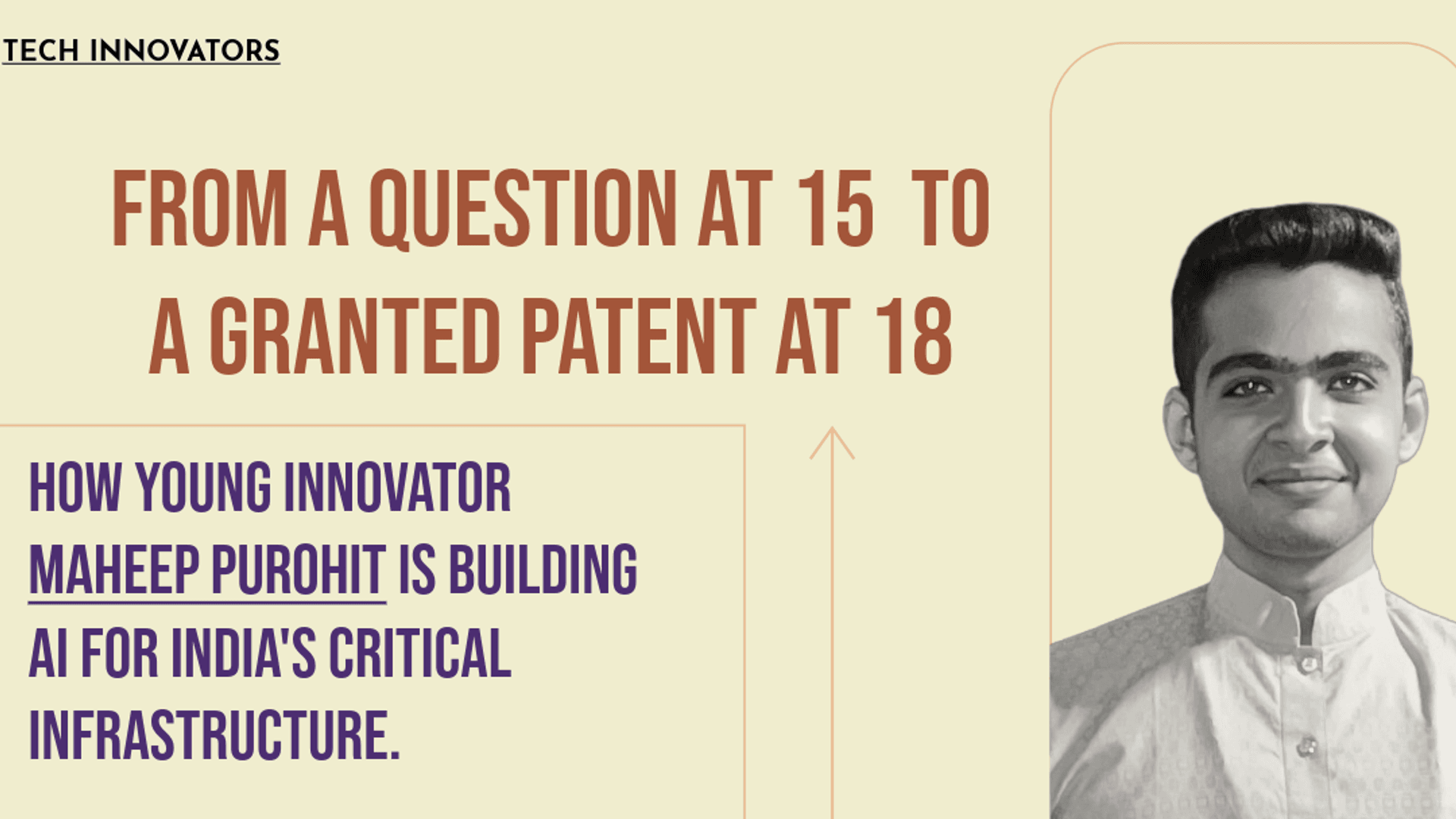
At a time when Artificial Intelligence, Deep Tech, and critical infrastructure are redefining the future of industries, one of the most compelling innovation stories is emerging not from a large research lab or a multinational corporation, but from the journey of an 18-year-old innovator from Rajasthan.
Maheep Purohit has been granted an Indian patent for the Adaptive Intelligent Pipeline Integrity System (AIPIS)—an AI-powered pipeline integrity monitoring and predictive maintenance technology developed to help detect pipeline failures before they occur.
What makes the story remarkable is not only the patent itself, but the timeline behind it.
The journey began when Maheep was just 15 years old, driven by a deceptively simple question:
"Why do industries wait for pipelines to fail instead of predicting failures before they happen?"
That question became the foundation of years of independent learning, research, experimentation, and continuous refinement.
Pipelines transport some of the world's most valuable resources—including water, oil, natural gas, chemicals, and industrial fluids—forming the backbone of modern economies.
Yet ageing infrastructure, corrosion, leakage, structural degradation, and delayed maintenance continue to result in significant economic losses, environmental damage, operational downtime, and safety risks.
Across the world, industries continue to spend heavily on inspections and maintenance while many failures remain undetected until they become expensive emergencies.
AIPIS has been developed to change that approach.
Rather than relying solely on scheduled inspections, the technology combines Artificial Intelligence (AI), Internet of Things (IoT), intelligent sensor networks, edge computing, and real-time data analytics to continuously monitor pipeline health.
By analysing operational data in real time, AIPIS is designed to identify early indicators of corrosion, pressure abnormalities, leakage, vibration anomalies, and structural degradation—supporting predictive maintenance instead of reactive repairs.
The objective is straightforward: improve safety, reduce resource losses, lower maintenance costs, and extend the operational life of critical infrastructure.
While receiving an Indian patent marks a significant milestone, the larger story is about the changing face of Indian innovation.
For years, innovation was often associated with established institutions and experienced professionals. Today, access to knowledge, open research, and digital technologies has enabled young innovators to contribute meaningfully to complex engineering challenges.
Maheep's journey reflects this transformation.
Without waiting for the "right age" or ideal circumstances, he chose to begin learning, experimenting, and building.
The result is not merely a patented technology—it is an example of what sustained curiosity and disciplined problem-solving can achieve.
India is rapidly emerging as a global hub for Artificial Intelligence, Deep Tech, and engineering innovation.
As the nation advances toward the vision of Viksit Bharat 2047, the role of young researchers, inventors, and entrepreneurs will become increasingly important.
The next generation will not simply adopt technology—they will create it.
They will build solutions for infrastructure, healthcare, manufacturing, agriculture, climate resilience, and sustainability.
Stories like Maheep Purohit's demonstrate that innovation is no longer defined by age, geography, or access to large resources. It is defined by the ability to identify meaningful problems and remain committed to solving them.
For Maheep, the granted patent is not the destination—it is the first milestone in a much longer journey.
The vision behind AIPIS (Adaptive Intelligent Pipeline Integrity System) is to contribute to safer, smarter, and more resilient infrastructure through indigenous AI-driven engineering.
More importantly, his journey sends a message to aspiring innovators across the country:
There is no age for innovation.
With a clear purpose, continuous learning, and unwavering dedication, ideas developed by young minds today can become the technologies that shape tomorrow's India.
As India builds the foundations of a Viksit Bharat 2047, it is these ideas—and the people willing to pursue them—that will define the nation's next chapter of innovation.