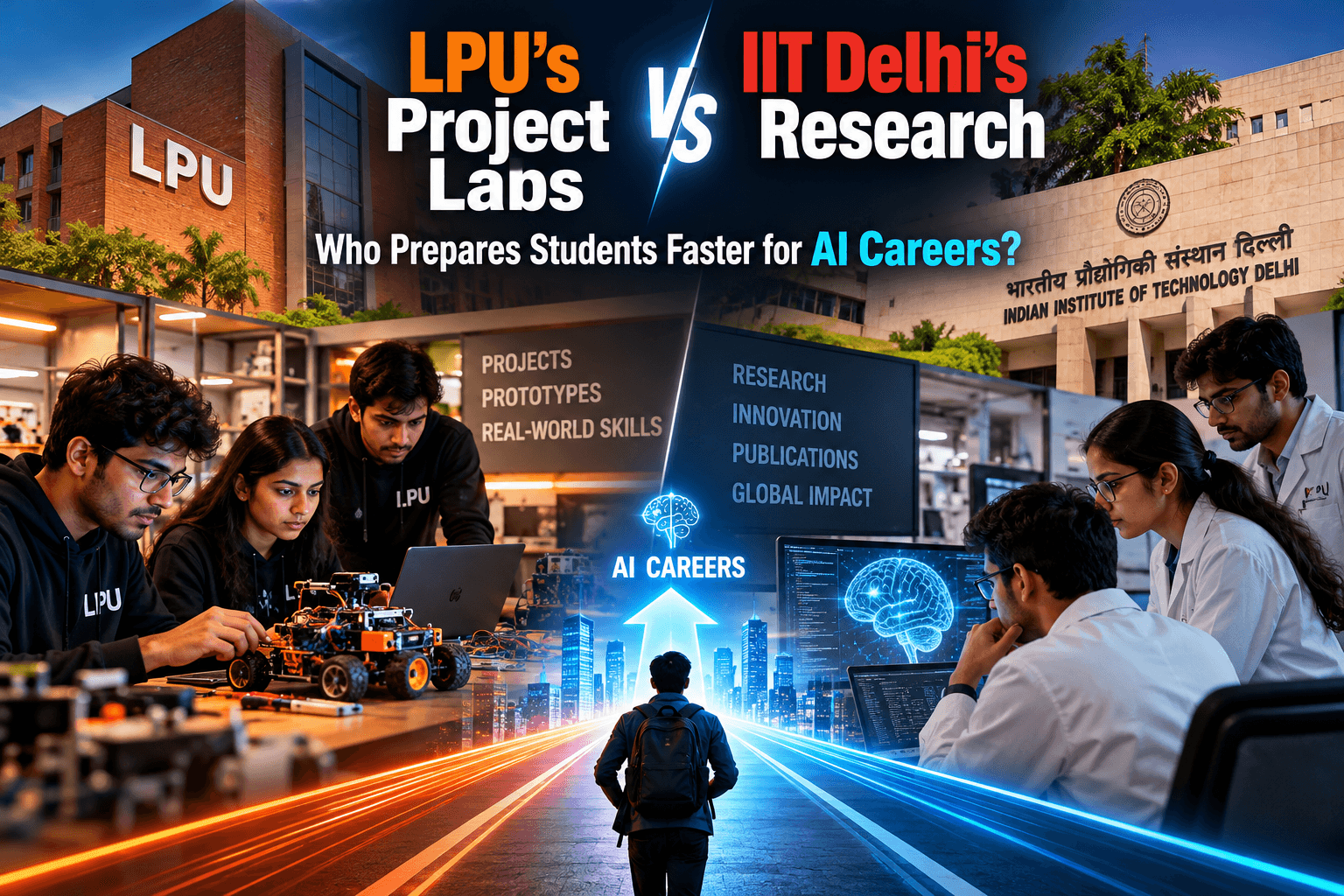
When Arjun Sharma walked into the crowded career fair at Chandigarh, the glossy brochure from Lovely Professional University (LPU) sat beside a sleek banner from the Indian Institute of Technology Delhi. Both promised a fast‑track into “AI‑Data Analytics” careers, but the stakes were different. LPU highlighted a partnership with IBM Watson that would let students “build real‑world solutions in weeks,” while IIT Delhi boasted a faculty‑led research lab that had just published a paper on federated learning for mobile health. For a student from a modest background, the decision felt less like choosing a university and more like betting on a future in a market that now demands data‑savvy engineers who can hit the ground running. The choice between a private university’s industry‑centric model and the Indian Institutes of Technology’s research‑heavy pedigree is no longer academic—it is a career‑defining gamble.
Curriculum Design and Pedagogy: Theory vs. Application
The first point of divergence lies in how each institution builds its AI‑Data Analytics syllabus. LPU’s program, launched under the banner of its Center for AI & Data Science, leans heavily on project‑based learning. Courses are structured around “industry‑sponsored labs,” where students spend a semester developing end‑to‑end pipelines for clients such as Accenture and Cognizant. The curriculum integrates tools like IBM Watson Studio, Microsoft Azure AI, and Tableau, with a clear emphasis on deployment, cloud‑cost optimisation, and rapid prototyping. Guest lectures from senior engineers at these partner firms are a weekly fixture, and the assessment model rewards functional deliverables over traditional exams.
In contrast, the IITs retain a more traditional engineering pedagogy, albeit one that has been progressively infused with data‑centric modules. At IIT Delhi, the Centre for Machine Intelligence and Data Science (CMIDS) curates a core set of courses that start with rigorous probability, linear algebra, and statistical learning theory before moving to deep learning, reinforcement learning, and large‑scale data processing. Faculty such as Prof. Anupam Joshi, a pioneer in AI governance, ensure that students grapple with the mathematical underpinnings of algorithms. The IIT model still relies on semester‑long examinations, but it supplements them with research seminars where students present findings from ongoing projects, often in collaboration with the Indian Institute of Science’s AI Initiative.
Both approaches have merit. LPU’s “learning‑by‑doing” format translates directly into a portfolio of deployable artifacts that recruiters can demo in an interview. IIT’s depth equips graduates with the analytical flexibility to design novel models, a skill set that high‑tech R&D labs prize. The crucial question for industry readiness is whether a company needs immediate delivery capability or a capacity for long‑term innovation. The data‑driven market in India, where firms such as Swiggy and Ola are scaling predictive logistics platforms, appears to value a hybrid of both—a reality that each institution claims to address in its own way.
Industry Integration: Internships, Live Projects, and Placement Outcomes
The rubber meets the road when students step into corporate environments. LPU has institutionalised a “Corporate Immersion Programme” that guarantees a three‑month internship for every enrollee. Through its AI Academy, the university channels students into projects for IBM’s “AI for Good” initiative, where they develop chatbots for rural health clinics, and into Accenture’s “Data Lake” migration assignments for banking clients. These stints are not merely observational; students are given production‑level responsibilities, from data ingestion to model monitoring, and they earn a stipend that rivals entry‑level salaries at many startups.
IITs, while historically known for campus placements, have refined their industry liaison offices to focus on data‑centric roles. IIT Delhi’s Placement Cell now runs a “Data Science Track” that partners with firms like Amazon, Google, and Reliance Jio. The process involves a pre‑placement hackathon where teams solve a real business problem—such as demand forecasting for JioMart—using anonymised data sets supplied by the company. Successful teams receive interview callbacks, and many are offered full‑time roles before graduation. Moreover, IIT Bombay’s Centre for Machine Learning runs an “Industry‑Sponsored Research” scheme, allowing students to co‑author papers with engineers from Microsoft Research India, thereby blurring the line between academia and corporate R&D.
Placement statistics reflect these differing emphases. LPU graduates often secure roles as “AI Solution Engineers” or “Data Analytics Consultants” within six months, joining firms that prioritize rapid deployment of analytics dashboards and AI‑enhanced customer service bots. IIT alumni, on the other hand, tend to be hired as “Machine Learning Scientists” or “Research Engineers,” positions that involve longer development cycles and deeper algorithmic work. Both pathways feed the burgeoning AI talent pipeline, but the nature of the jobs—operational versus exploratory—maps directly onto the institutional focus.
Ecosystem and Research Impact: Labs, Patents, and Startup Culture
Beyond the classroom, the surrounding ecosystem determines how well a graduate can stay ahead of the curve. LPU’s campus houses an “Innovation Hub” where a 100‑seat maker space is equipped with Nvidia DGX stations, edge‑device labs, and a partnership with the startup accelerator GSF. Here, students have launched ventures like “AgriSense,” an AI‑driven crop‑health monitoring platform that secured seed funding from a venture firm linked to the university’s alumni network. The hub’s open‑source policy encourages students to publish code on GitHub, fostering a community of practice that aligns with industry’s agile development culture.
The IIT ecosystem, meanwhile, is built around world‑class research facilities. IIT Delhi’s CMIDS operates a high‑performance computing cluster that supports large‑scale experiments in natural language processing and computer vision. Faculty members routinely file patents—recently a joint patent with a Bengaluru fintech firm for a privacy‑preserving credit‑scoring model. Moreover, IIT alumni have founded a slew of AI‑centric startups that have attracted Series A and B funding, such as a Bengaluru‑based autonomous‑driving analytics firm that now partners with a major automobile OEM. The presence of these alumni networks creates a virtuous loop: graduates gain mentorship from founders who once walked the same halls, and they inherit a culture that values publishing in top conferences like NeurIPS and ICML.
The divergence is subtle but consequential. LPU’s ecosystem accelerates the translation of classroom projects into market‑ready products, feeding a pipeline of “product‑first” engineers. IIT’s research‑heavy environment nurtures “knowledge‑first” technologists who can push the theoretical boundaries of AI, often leading to high‑impact patents and publications. For employers, the choice hinges on whether they need talent that can immediately ship a data product or innovators who can create the next generation of AI algorithms.
Cost, Accessibility, and Student Experience: The Hidden Variables
Financial considerations and student life factors often tip the scales in a decision that appears purely academic. LPU’s tuition for the AI‑Data Analytics program is positioned as “affordable for the middle class,” with a fee structure that includes a scholarship scheme tied to merit and need. The university also offers a “pay‑after‑placement” model for a limited cohort, allowing students to defer a portion of fees until they secure a job. Campus life at LPU is characterised by a sprawling urban setting, a vibrant student community, and a range of extracurricular clubs, from robotics to data journalism, which provide informal learning opportunities.
IITs, by contrast, command a higher tuition fee, justified by the institution’s brand equity and research infrastructure. However, the IIT system provides a robust financial aid framework, including need‑based scholarships and stipends for research assistants. The student experience at an IIT is often described as “intense” and “high‑performing,” with a culture that encourages deep focus on technical mastery. While the campus environment may be more austere, the network effect is powerful: alumni from IITs occupy senior leadership positions across the Indian tech ecosystem, from CEOs of multinational firms to heads of AI divisions in government ministries.
Accessibility also varies. LPU’s multiple campuses across northern India make it geographically reachable for students from tier‑2 and tier‑3 cities, while IIT admissions remain highly competitive, with a national entrance exam that filters a massive applicant pool down to a few hundred seats per institute. For aspirants who may not crack the exam but still desire a structured AI education, LPU presents a viable pathway. Conversely, for those who secure an IIT seat, the brand’s cachet can open doors that are otherwise difficult to access, especially in multinational corporations that place a premium on the IIT label.
The Strategic Bet: How Your Choice Shapes India’s AI Future
Choosing between LPU and an IIT for an AI‑Data Analytics degree is ultimately a strategic bet on the kind of AI talent the Indian economy will need in the next decade. The nation’s tech landscape is bifurcating into two parallel tracks: a massive wave of AI‑enabled products that demand engineers who can integrate models into existing business workflows, and a high‑impact research frontier where breakthroughs in federated learning, responsible AI, and quantum‑ready analytics will dictate global competitiveness. LPU’s model, with its industry‑driven labs and rapid‑deployment mindset, feeds the former. IITs, with their deep‑theory curriculum and research collaborations, feed the latter.
For corporations, the implication is clear. Companies building consumer‑facing analytics platforms—such as fintech firms developing credit‑risk engines—will find immediate value in LPU graduates who can spin up pipelines, manage cloud resources, and communicate insights to non‑technical stakeholders. Enterprises that invest heavily in R&D—like autonomous‑vehicle manufacturers or pharmaceutical AI labs—will gravitate toward IIT alumni who can design novel algorithms, navigate complex theoretical trade‑offs, and contribute to peer‑reviewed research. From a policy perspective, the government’s push for AI‑driven public services, from smart city initiatives to agricultural advisory systems, will require a blend of both skill sets, underscoring the need for a diversified educational ecosystem.
The market signal is already emerging: job postings that list “AI‑Data Analytics – production experience” are proliferating, while those that demand “publications in top AI conferences” remain niche but high‑paying. As the AI talent pool matures, the line between product engineering and research will blur, and institutions that can fuse LPU’s industry immersion with IIT’s research rigor may become the new gold standard. For now, students must align their career aspirations with the distinct strengths each institution offers, recognizing that the decision will not just shape their personal trajectory but also influence how India’s AI engine powers the next wave of digital transformation.
In an era where data is the new oil and AI the refinery, the right educational partner can be the catalyst that turns raw talent into market‑ready expertise. Whether you gravitate toward LPU’s fast‑track, industry‑centric labs or IIT’s deep‑theory, research‑rich environment, the choice will echo through the projects you build, the problems you solve, and the future of India’s AI economy.