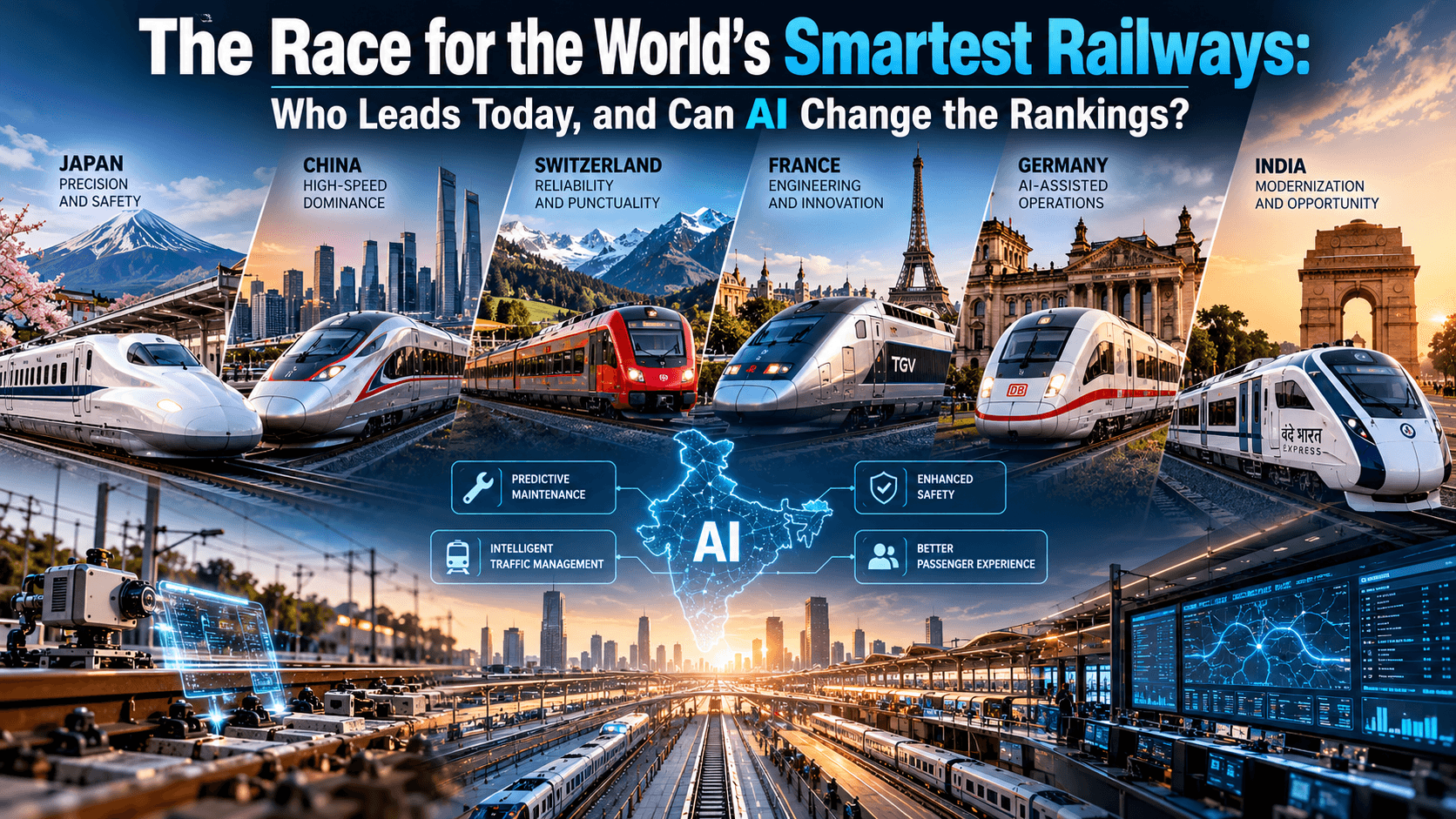
For more than two centuries, railways have played a defining role in economic development, industrial growth and national connectivity. From the steam-powered locomotives of the nineteenth century to modern trains travelling at more than 300 kilometres per hour, railway technology has continuously transformed how people and goods move.
Today, however, a new technological competition is emerging.
The future of railways is no longer being determined solely by the speed of trains, the length of railway networks or the scale of infrastructure investment. Countries are increasingly competing on operational efficiency, passenger safety, punctuality, predictive maintenance, automation and the integration of artificial intelligence.
Japan has established a global reputation for high-speed railway reliability. China operates the world's largest high-speed rail network. Switzerland demonstrates exceptional railway punctuality, while Germany and France are exploring increasingly sophisticated applications of artificial intelligence in railway operations.
Meanwhile, India is undertaking one of the world's most ambitious railway modernization programs, introducing modern rolling stock, expanding automatic train protection systems and experimenting with AI-powered inspection technologies.
But an important question remains: Is India genuinely competing with the world's leading railway systems, or is it still working to close the technological gap?
To understand the answer, it is necessary to examine what makes the world's leading railways successful, how artificial intelligence is transforming the industry and what India must change to become a serious international competitor.
The Global Railway Race: Which Country Leads?
There is no single internationally accepted ranking that identifies the world's best railway system across every performance category.
A railway network can be evaluated through multiple indicators, including train speed, network capacity, safety, punctuality, infrastructure quality, passenger experience and technological innovation.
Different countries lead in different areas.
Japan: The Global Benchmark for Railway Precision
Japan's Shinkansen, commonly known as the bullet train, is among the most recognizable examples of advanced railway engineering.
Since its introduction in 1964, the Shinkansen has established a reputation for high-speed transportation, operational discipline and safety.
Its success is not simply the result of powerful trains. Japan has developed an integrated railway ecosystem combining dedicated high-speed infrastructure, automatic train control, preventive maintenance, earthquake detection systems and highly coordinated operations.
The Shinkansen demonstrates how railway reliability depends on the relationship between infrastructure, technology and operational management.
Japan's railway philosophy emphasizes preventing failures rather than merely responding to them.
This approach has made the country an important reference point for railway operators seeking to improve safety and service consistency.
China: The World's High-Speed Railway Infrastructure Leader
China represents a different model of railway development, built around extraordinary infrastructure expansion and large-scale engineering capability.
According to the International Union of Railways' 2025 High-Speed Rail Atlas, China had more than 47,800 kilometres of operational high-speed railway infrastructure at the end of 2024.
This makes China the world's largest high-speed railway network operator by a substantial margin.
China's development has been supported by major investments in dedicated corridors, domestic rolling-stock manufacturing, advanced signalling systems and centralized railway operations.
The country's Fuxing high-speed trains represent its growing technological capability in railway manufacturing and systems integration.
China has also been exploring intelligent railway technologies, including automated inspection, advanced traffic management and data-driven infrastructure monitoring.
Its principal advantage is scale.
However, network size alone does not establish superiority in every aspect of railway performance. High-speed infrastructure must also be assessed against operating costs, utilization, safety, punctuality and long-term financial sustainability.
Switzerland: Why Reliability Can Matter More Than Speed
Switzerland offers a particularly important lesson in railway excellence.
Unlike China and Japan, Switzerland has not built its railway reputation primarily around extremely high operating speeds.
Instead, the country has focused on integrated timetables, efficient connections, dependable infrastructure and coordinated passenger services.
Swiss Federal Railways reported passenger train punctuality of approximately 94.1% in 2025, its highest recorded annual performance.
This achievement demonstrates that railway quality cannot be measured by speed alone.
For passengers, a reliable train arriving at the scheduled time can provide greater practical value than a faster train operating unpredictably.
Switzerland's railway model highlights the importance of network-wide coordination, preventive maintenance and operational planning.
France: High-Speed Engineering Meets Predictive Maintenance
France has long been a major contributor to high-speed railway technology through its Train à Grande Vitesse, commonly known as TGV.
Beyond high-speed transportation, French railway operator SNCF has invested in connected trains and condition-based maintenance technologies.
Modern trains generate significant amounts of operational information through onboard sensors and diagnostic systems.
By analyzing these measurements, railway engineers can identify abnormal component behavior and investigate potential faults before they cause major disruptions.
Predictive maintenance represents an important change from traditional maintenance approaches.
Instead of relying exclusively on fixed inspection schedules, operators can increasingly use equipment condition to help determine when maintenance intervention is necessary.
This can improve asset availability, reduce avoidable failures and support more efficient maintenance planning.
Germany: Artificial Intelligence in Railway Traffic Management
Germany offers one of the most interesting examples of AI-assisted railway operations.
Deutsche Bahn has been developing and testing artificial intelligence tools to improve dispatching and reduce delays across busy railway networks.
Railway traffic management is highly complex because delays can spread rapidly through interconnected services.
A late train may occupy a platform required by another service, creating further conflicts and affecting multiple routes.
AI systems can analyze train movements, infrastructure availability and scheduling constraints to recommend operational adjustments.
According to Deutsche Bahn's 2025 reporting, its AI-assisted dispatching applications helped avoid approximately 95,000 minutes of delays during the year.
However, Germany also demonstrates that advanced technology does not automatically guarantee superior railway performance.
Deutsche Bahn reported long-distance passenger punctuality of approximately 60.1% in 2025.
This contrast highlights an essential reality: artificial intelligence can improve operational decisions, but it cannot independently overcome inadequate infrastructure capacity, aging assets or prolonged maintenance backlogs.
How Artificial Intelligence Is Transforming the Railway Industry
Artificial intelligence is gradually changing the way railway operators maintain infrastructure, manage traffic, inspect equipment and respond to operational risks.
Traditionally, railway maintenance has depended heavily on scheduled inspections, periodic testing and human observation.
These methods remain essential, particularly for safety-critical infrastructure. However, they do not always provide continuous visibility into how equipment conditions change between inspections.
AI creates opportunities to analyze large volumes of operational information and identify patterns that may be difficult to recognize through conventional monitoring.
The International Union of Railways and McKinsey have identified more than 100 potential AI applications across railway operations, with an estimated annual global economic opportunity of approximately $13 billion to $22 billion.
These figures represent modeled potential rather than benefits already achieved by railway operators.
Several applications are particularly significant.
Predictive Maintenance: Detecting Problems Before Equipment Fails
Railway infrastructure contains thousands of components whose condition directly affects operational reliability.
These include railway tracks, switches, signalling equipment, wheel bearings, traction systems, bridges and overhead electrical infrastructure.
Unexpected equipment failure can interrupt services, create safety risks and increase maintenance costs.
AI-supported predictive maintenance systems analyze measurements such as vibration, temperature, electrical current, acoustic signals and equipment performance.
Machine-learning models can identify unusual patterns and help engineers investigate developing problems.
For example, an abnormal vibration signature in a railway switch may indicate mechanical deterioration requiring inspection.
Similarly, temperature and acoustic measurements may help identify potential bearing problems before a component experiences serious damage.
The objective is not to replace railway engineers or eliminate scheduled inspections.
It is to provide additional evidence that helps maintenance teams identify risks earlier and prioritize intervention more effectively.
Intelligent Traffic Management: Preventing Delays From Spreading
Railway traffic management requires constant coordination between train movements, signalling systems, platform availability and infrastructure capacity.
On heavily utilized routes, even minor disruptions can affect numerous services.
AI-assisted traffic management can analyze real-time operating conditions and predict where scheduling conflicts may occur.
These systems can recommend alternative train sequences, platform assignments or operational adjustments within established safety constraints.
Such applications are particularly valuable in densely utilized railway networks where passenger and freight services share infrastructure.
However, AI recommendations must remain compatible with certified signalling and train protection systems.
Safety-critical decisions require clearly defined operational authority, independent safeguards and rigorous validation.
Computer Vision: Automating Railway Inspection
Computer vision is another promising technology for railway infrastructure monitoring.
Cameras installed on inspection vehicles or alongside railway tracks can collect images of rails, wheels, fasteners and other components.
AI models can analyze these images to identify visible defects, missing components or abnormal conditions.
When combined with thermal imaging, acoustic monitoring and other sensing technologies, computer vision can support more comprehensive inspection processes.
However, performance depends on image quality, weather, lighting conditions, equipment placement and the accuracy of the underlying AI models.
Consequently, automated inspection technologies require extensive real-world testing before they can be trusted for critical operational applications.
Digital Twins: Creating Virtual Railway Networks
A digital twin is a digital representation of a physical asset, infrastructure system or operational environment.
In railway applications, digital twins can combine infrastructure information, operating data and simulation models to help engineers understand how different decisions may affect network performance.
For example, a railway operator could simulate the consequences of temporarily closing a track section for maintenance.
The model could help evaluate alternative schedules, identify possible bottlenecks and compare operational strategies.
Digital twins can also support long-term infrastructure planning by examining how changes in traffic demand may affect capacity.
Their effectiveness depends on accurate models, reliable data and continuous validation against actual railway conditions.
AI-Based Passenger Management
Artificial intelligence can also improve the passenger experience.
Railway operators can use demand forecasting to estimate crowding, predict passenger flows and improve service planning.
AI-supported information systems can provide more accurate disruption forecasts and help passengers make better travel decisions.
At major railway stations, passenger-flow analytics can assist operators in identifying congestion risks and allocating operational resources.
These applications may not attract the same attention as high-speed trains, but they can significantly influence the everyday quality of railway transportation.
Is India Really Competing? Where Indian Railways Stands in 2026
India occupies a distinctive position in the global railway industry.
It operates one of the world's largest railway networks and carries enormous volumes of passengers and freight across diverse geographical and operating conditions.
The country's railway system is also undergoing substantial modernization through new rolling stock, electrification, station redevelopment, safety technologies and digital infrastructure.
However, India's position changes considerably depending on the metric being examined.
In terms of operational scale and the complexity of mixed passenger-and-freight services, India is already a major international railway power.
In dedicated high-speed railway infrastructure, consistent passenger punctuality and comprehensive deployment of advanced train protection technologies, India remains behind several established international leaders.
This distinction is essential.
India's Vande Bharat trains represent important progress in domestic rolling-stock manufacturing, passenger amenities and modern train technology.
But operating a modern train on an existing conventional railway corridor is fundamentally different from operating a high-speed train on dedicated infrastructure.
Japan and China have invested decades in developing specialized high-speed railway networks.
India's first dedicated high-speed railway project, the approximately 508-kilometre Mumbai–Ahmedabad corridor, remains under construction as of October 2026.
Therefore, India cannot yet be considered a direct competitor to China or Japan in operational dedicated high-speed railway capacity.
Nevertheless, the country's technological development extends beyond train speed.
Kavach: India's Indigenous Railway Safety Technology
One of India's most important railway technology initiatives is Kavach, an indigenously developed Automatic Train Protection system.
Kavach is designed to monitor train movement against signalling and speed restrictions and intervene automatically when necessary.
Its purpose is to reduce risks associated with unsafe train movements and potential collisions.
According to Ministry of Railways reporting from August 2026, Kavach 4.0 had been commissioned across approximately 2,633 route kilometres.
This represents meaningful progress in India's domestic railway safety engineering capabilities.
However, Kavach should not be described as a general-purpose artificial intelligence system.
It is an automatic train protection technology based on defined signalling and control functions.
AI could complement such infrastructure by monitoring equipment health, analyzing diagnostic information and supporting maintenance planning.
The larger challenge for India is to expand reliable deployment across appropriate railway corridors while maintaining interoperability, safety certification and long-term operational performance.
India's Emerging AI Railway Ecosystem
India has already begun experimenting with AI-supported railway technologies.
Government updates released in 2026 describe initiatives involving machine-vision inspection, rolling-stock monitoring, wheel impact detection and intelligent track monitoring.
These systems are intended to help identify infrastructure defects, monitor equipment conditions and improve maintenance processes.
Indian Railways has also pursued AI-enabled video surveillance at railway stations and technology development for improved visibility during adverse weather.
These initiatives indicate that India recognizes the strategic importance of artificial intelligence in railway modernization.
However, there is an important difference between deploying AI in selected applications and operating an integrated AI-enabled railway network.
A nationwide intelligent railway system would require coordinated data collection, reliable communications, interoperable platforms, standardized maintenance records and effective integration between operational departments.
India's present challenge is therefore not simply introducing more AI technologies.
It is converting individual technology deployments into a consistent, measurable and scalable operational capability.
What India Must Change to Compete With the World's Leading Railways
If India intends to become a global railway technology leader, modernization must extend beyond faster trains and visible infrastructure projects.
The country needs a coordinated strategy combining infrastructure reliability, safety engineering, operational intelligence and domestic technological innovation.
Several priorities deserve particular attention.
1. Move Toward Continuous Railway Infrastructure Monitoring
India's railway infrastructure operates under demanding environmental and operational conditions.
Extreme temperatures, monsoon rainfall, dust, heavy freight loads and dense train movements can influence infrastructure deterioration.
Traditional inspections provide valuable information, but they generally represent equipment conditions at particular moments.
Between inspections, infrastructure behavior can change.
India should progressively evaluate continuous or high-frequency condition monitoring for selected critical railway assets.
Sensors could measure vibration, temperature, acoustic behavior, electrical characteristics and other relevant indicators.
AI models could analyze these measurements to identify abnormalities and support maintenance decisions.
Such systems should initially be deployed on high-risk corridors, critical junctions and infrastructure with recurring reliability problems.
Expansion should depend on demonstrated performance rather than technology availability alone.
2. Develop an Integrated Railway Intelligence Architecture
One of the greatest barriers to effective AI deployment is fragmented operational data.
Railway infrastructure, signalling, rolling stock, maintenance and scheduling systems generate different types of information.
When these systems operate independently, it becomes difficult to identify relationships between infrastructure conditions and operational disruptions.
India should develop secure and interoperable data systems that allow authorized departments to exchange relevant information.
For example, recurring signalling failures could be analyzed alongside equipment condition, maintenance history, environmental conditions and operational records.
This would help engineers identify patterns and investigate underlying causes.
However, integration must not compromise safety-critical railway control systems.
Strong cybersecurity, controlled access, data quality standards and independent safety boundaries would be essential.
3. Introduce AI-Assisted Railway Traffic Optimization
India's high-density railway corridors present an important opportunity for intelligent traffic management.
On busy routes, passenger and freight trains compete for limited infrastructure capacity.
Even small disruptions can create significant scheduling conflicts.
AI-assisted dispatching could help operators predict conflicts, evaluate alternative train sequences and improve disruption recovery.
Germany's experience provides a useful example of how these technologies can support operational decision-making.
For India, initial deployments should focus on carefully selected corridors with measurable congestion and delay problems.
The success of these systems should be evaluated through reductions in delay minutes, improved punctuality, better asset utilization and faster recovery following disruptions.
AI cannot eliminate physical capacity constraints, but it may help railway operators use existing infrastructure more effectively.
4. Strengthen Railway AI Testing and Certification
Introducing artificial intelligence into railway operations requires a higher standard of validation than many ordinary software applications.
Railway environments are safety-sensitive, and technology failures can have serious consequences.
India should establish rigorous evaluation procedures for AI-based monitoring and decision-support technologies.
These should examine detection accuracy, false alarms, reliability, cybersecurity, maintenance requirements and performance under varying environmental conditions.
Technologies should also be tested against real operating data and independently evaluated before large-scale deployment.
A successful pilot should not automatically be treated as evidence of nationwide readiness.
The transition from experimentation to operational deployment must be supported by documented engineering evidence.
5. Build a Stronger Domestic Railway Innovation Ecosystem
India has substantial technological capabilities across engineering institutions, research laboratories, manufacturers and emerging technology companies.
The challenge is connecting these capabilities to practical railway problems.
In 2026, Indian Railways introduced a Rail Tech Policy intended to encourage technological innovation and support the development of scalable railway solutions.
Such initiatives could become important mechanisms for involving domestic innovators in railway modernization.
A stronger innovation ecosystem would provide clearly defined operational challenges, access to controlled testing environments and transparent technology evaluation procedures.
Startups and research institutions could develop solutions for infrastructure monitoring, intelligent inspection, predictive maintenance and railway analytics.
Successful technologies could then progress through independent validation and structured procurement.
This approach could help India develop technologies suited to its own operating conditions rather than relying exclusively on solutions designed for different railway environments.
Can India Become a Global Leader in AI-Enabled Railways by 2035?
India has several advantages that could support its long-term position in railway technology.
Its extensive railway network provides opportunities to develop and validate systems under diverse operating conditions.
Its domestic technology industry has experience building large-scale digital platforms.
Its manufacturing ecosystem is expanding, and railway modernization continues to receive significant public investment.
However, these advantages alone will not guarantee global leadership.
China's high-speed infrastructure lead is substantial. Japan has decades of experience in high-speed operational reliability. Switzerland has established a highly coordinated passenger network, while European railway operators continue to invest in advanced maintenance and traffic management systems.
India cannot close every gap simply by purchasing new trains or installing AI software.
It must improve the foundations on which intelligent railway systems depend.
These include infrastructure quality, reliable operational data, safety engineering, maintenance standards, staff training and accountable performance management.
A practical modernization strategy could begin by validating AI-supported maintenance and inspection systems on selected corridors, expanding interoperable monitoring networks, introducing AI-assisted traffic optimization and gradually developing integrated railway digital twins.
By 2035, India could potentially establish a distinctive position in scalable, affordable railway intelligence technologies, particularly for large mixed-traffic networks.
Such systems could also have applications in countries facing similar infrastructure and operating challenges.
However, this outcome should be understood as a strategic possibility rather than a guaranteed forecast.
India's progress must ultimately be measured through independently verified improvements in safety, punctuality, reliability, operational efficiency and maintenance performance.
The Future of Railways: Intelligence May Matter More Than Speed
The global railway industry is entering a period in which artificial intelligence may become as important to operational performance as advances in train manufacturing and infrastructure engineering.
Japan demonstrates the value of precision and safety discipline. China shows the impact of large-scale infrastructure development. Switzerland highlights the importance of reliability and network coordination. France and Germany demonstrate how digital technologies can support maintenance and operational decisions.
Each country offers a different lesson.
For India, the challenge is not necessarily to reproduce any one of these railway systems.
It is to combine international best practices with domestic engineering capabilities and the unique requirements of its vast railway network.
India is already a major railway nation. It is investing in modern rolling stock, automatic train protection and intelligent inspection technologies.
But becoming a global railway technology leader will require more than isolated innovations.
It will demand integrated infrastructure intelligence, rigorous technology validation, dependable maintenance systems and measurable operational improvements.
The next generation of railway leadership may not be defined exclusively by which country operates the fastest train or builds the longest route.
It may be defined by which country can predict failures before they happen, prevent disruptions from spreading, manage infrastructure more efficiently and deliver dependable transportation at scale.
The future of Indian Railways will not be determined only by how fast its trains can travel, but by how intelligently the country can operate, maintain and protect the network it already possesses.
And in that competition, India has both a significant opportunity and considerable work ahead.
Research References
- International Union of Railways (UIC) — High-Speed Rail Atlas, 2025 Edition.
- Deutsche Bahn — Integrated Report 2025, including digitalization and operational performance.
- Swiss Federal Railways (SBB) — 2025 Punctuality and Performance Reporting.
- Ministry of Railways, Government of India — Press Information Bureau releases on Kavach 4.0, August 2026.
- Ministry of Railways, Government of India — 2026 updates on artificial intelligence, machine-vision inspection and railway modernization.
- UIC and McKinsey — Research on artificial intelligence applications and potential economic value in the global railway industry.
Editorial note: International railway performance figures may use different reporting definitions and should not be treated as a standardized global ranking. Proposed AI applications and future scenarios are distinguished from technologies already in operational service.